Jun 26, 2026
Choosing a Shopify website development company is one of the most important decisions a growing ecommerce brand makes. The right partner builds a store that consistently converts visitors into buyers. The wrong one delivers something that may look acceptable but underperforms from day one.
After building over 65 Shopify stores for brands across India, USA, UK, and Australia since 2014, we have seen both sides of this equation. This guide will help you make a genuinely informed decision before hiring a Shopify development partner.
Why Your Choice of Shopify Development Company Matters More Than You Think
Most business owners focus on price when comparing Shopify development companies. That is understandable. But price is one of the least reliable indicators of the outcome you will actually get.
What matters more is whether the company:
-
- Understands ecommerce conversion
-
- Communicates clearly throughout the project
-
- Builds a store your team can manage confidently after launch
A Shopify store built by the wrong partner often looks fine on the surface.
The real issues appear later:
-
- Slow load times
-
- Mobile checkout problems
-
- Difficult product management
-
- Poor admin usability
-
- Dependence on developers for small updates
These problems usually cost far more to fix than they would have cost to prevent.
7 Things to Look for Before Hiring a Shopify Website Development Company
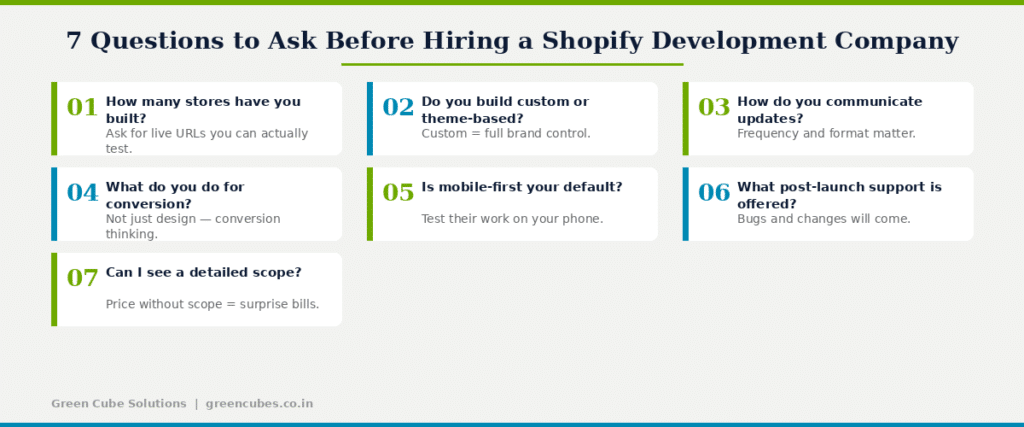
1. A Portfolio of Real Shopify Stores — Not Just Screenshots
Any serious Shopify development agency should be able to show live Shopify stores, not just images or mockups.
Visit the actual websites and test them yourself.
What to Check:
-
- Do pages load quickly on mobile?
-
- Is navigation clear and intuitive?
-
- Does checkout feel smooth?
-
- Do product pages answer buyer questions effectively?
If the answer to any of these is no, the agency likely has a capability gap regardless of how polished the portfolio presentation looks.
2. Experience With Custom Shopify Development — Not Just Theme Setup
There’s a significant difference between customizing an existing Shopify theme and building a fully custom store from design files.
Theme-based stores are often faster and more affordable, but they can limit flexibility and brand uniqueness. If your business needs a tailored shopping experience, choose a company that can build directly from Figma or other custom design systems.
Ask this question:
- Do you build Shopify stores from custom designs, or do you mainly customize existing themes?
3. A Clear and Honest Communication Process
Strong communication is just as important as technical expertise. Many projects run into trouble because updates become infrequent, questions go unanswered, or issues aren’t addressed until launch.
Ask before hiring:
- How often will we receive project updates?
- How do you handle unexpected challenges?
- Who will be our primary point of contact?
Clear, confident answers are often a better indicator of a successful partnership than the quoted price.
4. Mobile-First Development Should Be Standard
With most ecommerce traffic now coming from mobile devices, your Shopify store must perform flawlessly on smartphones.
What you should do:
- Review mobile versions of completed Shopify stores.
- Test them yourself.
- Check performance using mobile data instead of Wi-Fi for a realistic experience.
If the mobile experience feels noticeably weaker than the desktop version, mobile-first development is likely not part of the agency’s standard process.
5. Understanding Conversion Rate Optimisation (CRO)
A successful Shopify store is designed to generate sales, not just look attractive.
An experienced agency should consider factors such as:
- Checkout flow
- Product page structure
- Trust signals
- CTA placement
- Page speed
- Mobile usability
Ask:
- How do you improve conversion rates?
- What strategies do you use to increase add-to-cart performance?
- How do you optimize the checkout experience?
Companies that provide specific examples rather than generic answers usually have stronger ecommerce expertise.
6. Post-Launch Support and Maintenance
Launching your Shopify store is only the beginning. As your business grows, you’ll likely need updates, bug fixes, design improvements, app integrations, and ongoing technical support.
Questions to ask:
- Do you offer maintenance plans?
- What is your typical support response time?
- Will we have a dedicated support contact?
Reliable post-launch support is often what turns a one-time project into a long-term partnership.
7. Transparent Pricing With a Detailed Scope
A trustworthy Shopify development company won’t provide a final quote without first understanding your requirements.
They should ask about:
- Your products
- Target audience
- Brand assets
- Required integrations
- Project timeline
- Business goals
If pricing is provided too quickly, there’s a higher chance of unexpected costs later.
Request a detailed written project scope before development begins. This helps prevent misunderstandings and keeps both parties aligned.
Red Flags to Watch Out For
Be cautious if you notice any of these warning signs:
- No live Shopify stores—only screenshots.
- Pricing significantly lower than competitors.
- Unrealistic delivery timelines.
- Slow or inconsistent communication during the sales process.
- No clear explanation of the development workflow.
Questions to Ask Before You Hire
Before choosing a Shopify website development company, ask:
- How many Shopify stores have you built, and can I see live examples?
- Do you build custom stores or primarily customize themes?
- Who will manage the project?
- What post-launch support do you provide?
- Have you worked with businesses in my industry?
- How do you improve conversion rates?
- What is included in the project scope, and what costs extra?
Why Experience Across Multiple Store Types Matters
Every industry has different ecommerce requirements.
For example:
- Fashion brands rely on visual merchandising and product discovery.
- Subscription businesses focus on recurring purchases.
- Jewellery brands require strong trust signals and premium presentation.
A development company with experience across multiple industries is better equipped to create solutions tailored to different customer journeys.
The Bottom Line
Choosing a Shopify website development company isn’t just about hiring a developer—it’s about selecting a long-term growth partner.
The right company will:
- Understand your business goals.
- Communicate clearly throughout the project.
- Build a Shopify store that converts visitors into customers.
- Continue supporting your business after launch.
Take the time to review live stores, test mobile performance, ask detailed questions, and evaluate the agency’s understanding of ecommerce—not just its design portfolio.
A well-built Shopify store is one of the best long-term investments an ecommerce business can make.
About Green Cube Solutions
Green Cube Solutions is a Shopify website development company based in Ahmedabad, India.
Since 2014, we’ve built custom Shopify stores for businesses across India, the USA, the UK, and Australia.
With 65+ successful Shopify store launches and a 4.9-star client rating, our goal is simple:
Build Shopify stores that drive conversions—not just stores that look good.
If you’re planning a Shopify store or looking to upgrade your existing one, our team is ready to help you build a high-performing ecommerce experience.

Miraj Mor
Miraj Mor is one of the young entrepreneur, leader and mind who invests a lot of time in the client relationship management and business development strategies. He is the backbone of the whole team.