Jun 26, 2026
Artificial intelligence has evolved from a buzzword into a practical business tool that Shopify store owners and developers are using to improve customer experience and increase conversions.
This isn’t about replacing your team or rebuilding your store from scratch. Instead, it’s about adding intelligent capabilities that make your Shopify store more responsive, personalized, and effective at turning visitors into customers.
At Green Cube Solutions, we’ve been building custom Shopify stores since 2014. Over the past two years, we’ve integrated AI-powered features into stores across multiple industries. This article explores five of the most impactful AI applications we’ve implemented—features we’ve built, tested, and seen deliver measurable results.
Why AI Matters in Shopify Store Development
The average ecommerce store converts only 1–3% of its visitors. In other words, more than 97 out of every 100 visitors leave without making a purchase.
Most of these lost sales happen for familiar reasons:
- Visitors can’t quickly find the products they need.
- Product recommendations aren’t relevant.
- The shopping experience feels generic.
- Questions remain unanswered during the buying journey.
AI helps solve these challenges by making Shopify stores smarter. Rather than redesigning the entire store, AI enables it to respond intelligently to each visitor’s behavior in real time.
5 AI Features We’re Building Into Shopify Stores in 2026
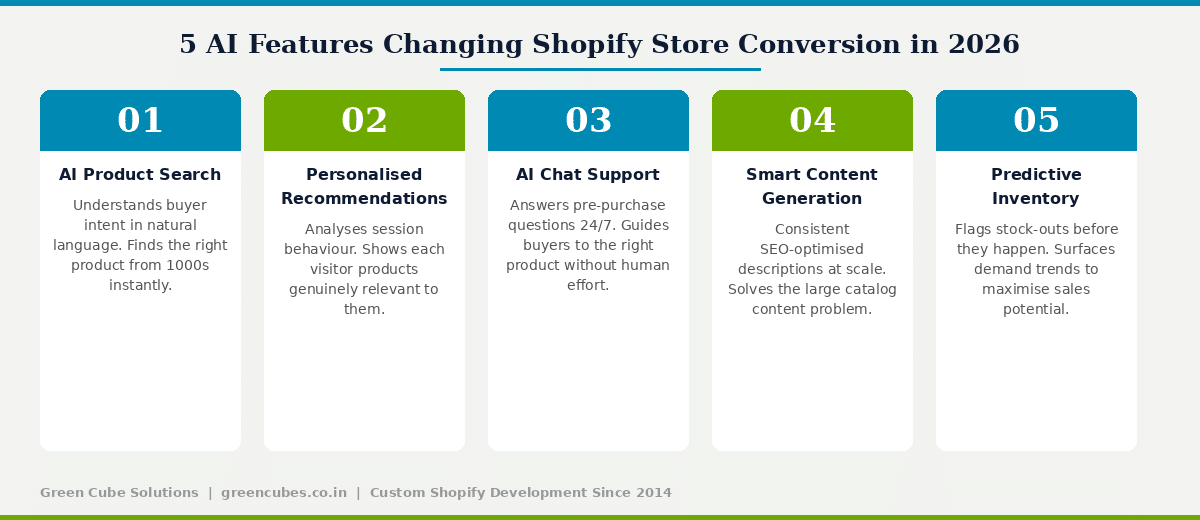
1. AI-Powered Product Search
Standard Shopify search relies on exact keyword matching. This works well when customers know the exact product name, but most shoppers search using natural language.
They describe problems rather than products, use synonyms, or make spelling mistakes.
AI-powered search understands search intent instead of simply matching keywords. For example, a customer searching a catalog with 40,000 products can describe what they’re looking for in plain language, and AI returns the most relevant results. Traditional search would likely return irrelevant products—or none at all.
We recently implemented this solution for a large Shopify catalog, and the improvement in product discovery was immediate and measurable.
For stores with hundreds or thousands of products, AI-powered search offers one of the highest returns on investment.
2. Personalized Product Recommendations
Traditional product recommendations often display the same best-selling products to every visitor.
AI recommendations analyze each visitor’s browsing behavior in real time, including:
- Pages viewed
- Categories explored
- Time spent on products
- Purchasing patterns of similar customers
Instead of showing the same recommendations to everyone, AI delivers products that are genuinely relevant to each visitor.
These recommendations are especially effective on:
- The homepage for returning visitors
- Product pages
- The shopping cart before checkout
Personalized recommendations consistently improve both conversion rates and average order value.
3. AI Chat Support and Product Guidance
Many Shopify stores either rely on live chat that’s only available during business hours or use basic chatbots that can answer only predefined questions.
Neither approach adequately supports customers shopping across different time zones.
An AI-powered assistant trained on your product catalog, FAQs, policies, and sizing guides can answer most customer questions around the clock.
More importantly, it can recommend products based on a customer’s specific needs. Instead of simply answering questions, it helps shoppers make informed purchasing decisions.
We’ve implemented AI assistants for both ecommerce stores and service businesses, significantly reducing unanswered pre-purchase questions while improving first-time buyer conversions.
4. AI-Assisted Product Description Generation
Writing compelling, SEO-friendly product descriptions for hundreds or thousands of products is one of the biggest content challenges for growing ecommerce businesses.
Many stores rely on short descriptions or copy manufacturer content, neither of which performs well for SEO or customer engagement.
AI helps generate structured, consistent, and optimized product descriptions while maintaining your brand’s tone of voice.
Rather than replacing human writers, AI accelerates content production, allowing large catalogs to be completed in weeks instead of months.
We regularly use AI-assisted content generation for Shopify clients with extensive product catalogs to ensure consistency and improve search visibility.
5. Predictive Inventory and Demand Insights
AI also improves business operations behind the scenes.
By analyzing historical sales data, seasonal trends, and demand patterns, AI can:
- Predict products likely to sell out.
- Identify products that deserve greater promotional focus.
- Highlight slow-moving inventory before it impacts profitability.
This helps businesses avoid two common inventory problems:
- Running out of best-selling products.
- Overstocking products with low demand.
Both directly affect revenue and customer satisfaction.
How to Approach AI Integration
One of the most common questions we receive is where businesses should begin with AI.
The answer depends on your biggest challenge.
- If customers struggle to find products, start with AI search.
- If average order value is low, implement personalized recommendations.
- If customer questions go unanswered, deploy AI chat support.
- If product content is inconsistent, use AI-assisted content generation.
Most AI features can be integrated into an existing Shopify store without requiring a complete rebuild.
The key is identifying the highest-impact problem and implementing the right solution without compromising store performance.
What AI Cannot Do
Despite its capabilities, AI isn’t a replacement for strong ecommerce fundamentals.
AI cannot compensate for:
- Poor product photography.
- Confusing navigation.
- Weak branding or lack of customer trust.
Successful Shopify stores still require:
- Fast loading speeds.
- Clear navigation.
- High-quality product pages.
- A seamless checkout experience.
AI enhances a well-built Shopify store—it doesn’t fix a poorly built one.
The Bottom Line
AI is no longer a future technology for ecommerce. It’s already helping Shopify businesses improve conversions, reduce cart abandonment, and create more personalized shopping experiences.
Brands adopting AI today are building a meaningful competitive advantage over stores that continue relying on static, one-size-fits-all experiences.
If you’re planning a new Shopify store or looking to improve an existing one, AI integration can help deliver measurable improvements when implemented strategically.
About Green Cube Solutions
Green Cube Solutions is a custom Shopify website development company based in Ahmedabad, India.
Since 2014, we’ve built more than 65 Shopify and WooCommerce stores for businesses across India, the USA, the UK, and Australia. Our experience spans industries including fashion, food, health, jewellery, industrial supply, and digital products.
We specialize in developing custom Shopify stores from design files and integrating AI solutions where they create real business value and improve the customer experience.

Miraj Mor
Miraj Mor is one of the young entrepreneur, leader and mind who invests a lot of time in the client relationship management and business development strategies. He is the backbone of the whole team.